
Learn at your own pace

Learn product management. Leave with proof.

90 lessons and 9 capstones build a public portfolio you can share. Free, permanently.

Illustration of a capstone page: Product Opportunity Brief & Problem Definition, from Module 1, Product Thinking Foundations, written by Sample Learner. Beside it, a public portfolio card and a Skill Radar chart.

Illustration. Content written for demonstration.

Portfolio

Finish with work you can show.

Publish the pieces you are proud of. Share one link. No login to view.

Nine briefs. Nine deliverables.

You write the opportunity brief, the PRD, the roadmap. You choose what goes public.

See a real portfolio
  1. Capstone 1:
    Opportunity Brief

    Product Opportunity Brief & Problem Definition

    Product Thinking Foundations

  2. Capstone 2:
    Discovery Artifact

    User Research Plan & Opportunity Solution Tree

    Users, Problems & Discovery

  3. Capstone 3:
    Full PRD

    Comprehensive Product Requirements Document (PRD)

    Defining Products & PRDs

  4. Capstone 4:
    Roadmap & Memo

    Quarterly Product Roadmap & Tradeoff Defense Memo

    Prioritization & Roadmaps

  5. Capstone 5:
    UX Design Spec

    UX Wireframe Critique & Interaction Design Spec

    Design, UX & Prototyping

  6. Capstone 6:
    Metrics & Experiment Spec

    North Star Metric Tree & A/B Experiment Spec

    Metrics, Growth & Experiments

  7. Capstone 7:
    Technical Tradeoff Brief

    System Architecture & API Integration Tradeoff Brief

    Technical Fluency for PMs

  8. Capstone 8:
    Alignment Plan

    Cross-Functional Stakeholder Alignment & Crisis Plan

    Stakeholders & Leadership

  9. Capstone 9:
    Comprehensive Portfolio Case Study

    End-to-End Product Case Study

    Capstone & Career Portfolio

Capstone titles as they appear in the curriculum.

What you leave with.

One link that shows your product work.

Drawn example of a public portfolio page for Sample Learner, showing the PM Fellow badge and three capstone titles from the curriculum.

Illustration. Content written for demonstration.

A certificate anyone can check.

Finish every lesson, add it to LinkedIn in one click, and share a public verification link.
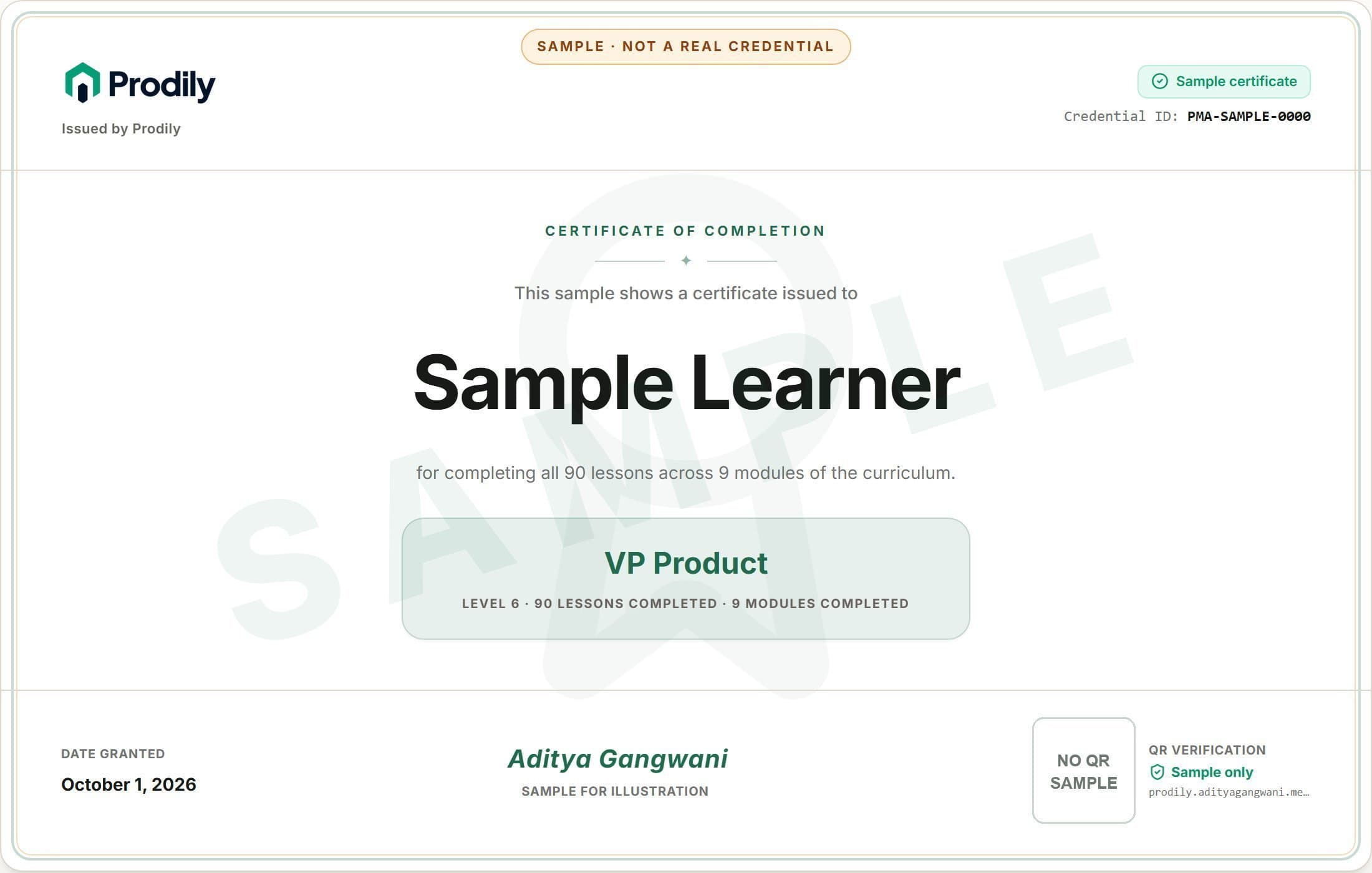
Sample certificate
Sample certificate made out to Sample Learner. Not a real credential.
Every real certificate has a public link anyone can open.
Illustration. Content written for demonstration.

PM Fellow. Earned, then reviewed.

Complete every item on the portfolio checklist and request review.

  • No fee, no shortcut.
  • A person on our team decides.
  • The badge sits on your public portfolio.

See where you are strong.

Seven product skills, scored from the lessons you finish and the quizzes you pass.

  1. Updates as you learn.
  2. Shows what to work on next.
  3. Appears on your portfolio.
Concept preview · Sample Learner

Showing the sample radar after Module 9.

  • Discovery & Research
  • Strategy
  • Design & UX
  • Execution & Delivery
  • Metrics & Growth
  • Leadership & Communication
  • Technical Fluency
Dashed outline shows Module 1. Illustration. Content written for demonstration.

Read, recall, apply, retain.

Four steps. The last one brings you back.

  1. Read.

    A concept explained plainly, with a worked example.

    Illustration of a page from Lesson 4, Product Lifecycle: a section heading, the start of the explanation and the lesson's framework.

    Illustration. Text from Lesson 4 of the course.
  2. Recall.

    Scenario quizzes that explain every answer, right or wrong.

    Illustration of a quiz question from Lesson 1: What is the primary distinguishing accountability of a Product Manager, compared to an engineer or designer? Four options, with the correct one marked.

    Illustration. Text from Lesson 1 of the course.
  3. Apply.

    Write the module capstone and keep it in your portfolio.

    Illustration of a capstone document titled Comprehensive Product Requirements Document (PRD), written by Sample Learner, with its section headings.

    Illustration. Content written for demonstration.
  4. Retain.

    Short reviews return just before you would forget. A few minutes a day.

    Illustration of a review card due today, asking: What are the three core questions a PM must answer, and in what order?

    Illustration. Text from Lesson 1 of the course.
  • Streaks.A daily habit, with freezes for off days.
  • Badges.Marks for real milestones.
  • Leaderboard.Optional, weekly.
  • Glossary and frameworks.Look up any term.

CURRICULUM

From first principles to a full case study.

Each module ends in a capstone.

See every lesson in the curriculum
  1. Module 1: Product Thinking Foundations

    10 lessons · 4–5 hrs

  2. Module 2: Users, Problems & Discovery

    10 lessons · 5–6 hrs

  3. Module 3: Defining Products & PRDs

    10 lessons · 5–6 hrs

  4. Module 4: Prioritization & Roadmaps

    10 lessons · 4–5 hrs

  5. Module 5: Design, UX & Prototyping

    10 lessons · 5–6 hrs

  6. Module 6: Metrics, Growth & Experiments

    10 lessons · 5–6 hrs

  7. Module 7: Technical Fluency for PMs

    10 lessons · 4–5 hrs

  8. Module 8: Stakeholders & Leadership

    10 lessons · 4–5 hrs

  9. Module 9: Capstone & Career Portfolio

    10 lessons · 6–8 hrs

Structure without the tuition.

Self-study has no sequence. Bootcamps cost money. Prodily gives you the sequence and the work, free.

Showing the sample learner as a course certificate.

Certificate of completion

This certifies that

Sample Learner

Online PM course.

Illustration. Content written for demonstration.

Questions.

Check it yourself

Is Prodily really free?

Yes. The core 90-lesson curriculum is free, permanently. There are no paywalled lessons blocking the main learning path.

Who is Prodily for?

It is built primarily for aspiring product managers, career switchers, students, and ambitious learners. It can also help founders, designers, engineers, analysts, and others who want stronger product judgment.

Do I need prior PM experience?

No. The curriculum starts with foundations and gradually moves into discovery, execution, strategy, leadership, and applied product work.

How do I get started?

Create a free account and start with the curriculum. You can begin with the first lesson and build from there.

See all questions

Learn product.Build the work.Show the proof.

Start your portfolio today.

Free. No trial, no card.